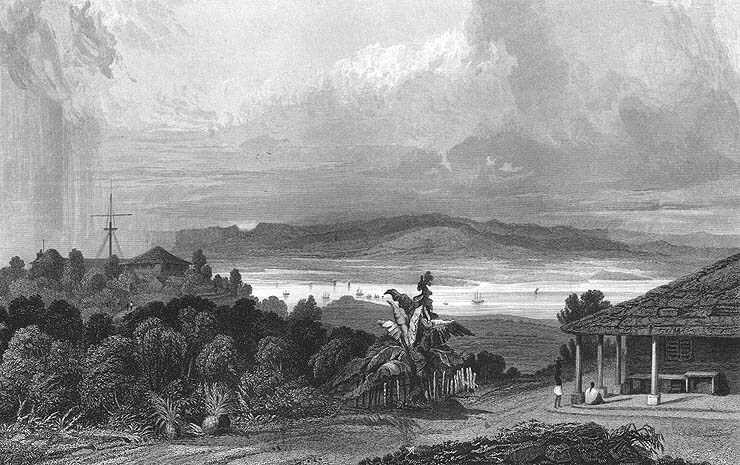
MALAYSIA, Penang Island Pulau Pinang PEARL OF ORIENT ~ 1842 Art Print Engraving
PULO PENANGArtist: S. Austin ____________ Engraver: S. LACEY Note: the title in the table above is printed below the engraving CLICK HERE TO SEE MORE ANTIQUE VIEWS OF THE CHINESE EMPIRE LIKE THIS ONE!! AN ANTIQUE STEEL ENGRAVING MADE IN THE EARLY 1840s !! ITEM IS OVER 150 YEARS OLD! VERY OLD WORLD! INCREDIBLE DETAIL! FROM THE ORIGINAL DESCRIPTION: Penang, Singapore, Hong-Kong, Shanghai, Manilla, and Australia. The island-270 miles long by 140 broad-lies off the southern extremity of the peninsula of Hindostan, from which it is separated by the Gulf of Manaar, and Palk's Strait. A long chain of islets and sand-banks in this strait and gulf, however, called Adam's Bridge, extending to the island of Manaar, nearly connects Ceylon with the peninsula. There is the greatest pearl-fishery in the world in the Gulf of Manaar; and Ceylon itself is famous for cocoa-nut trees; and also for its cinnamon and coffee. The native inhabitants are called Singalese; they chiefly inliabit the central and southern parts of the island. There are Hindoos on the north and north-eastern coasts. The remainder of the population-about 1,500,000 in all- consists of Moors and Mohammedans, of Arabian descent, and a few Europeans. The island is a dependency of the British government; and the governor resMes at Colombo. The other principal towns are Candy, Trincomalee, Pointe de Galle, Jaffna, and Newera Ellia. The latter, which is laid down in very few maps, is (according to Mr. Baker, who resided eight years in Ceylon) situated upon a plain, 6,300 feet above the level or the sea, at the distance of 185 miles from Pointe de Galle, 115 from Colombo, and 47 from Candy. Its situation appears to be one of the most delightful that can be imagined. It is considered the Ceylon sanatorium; and many an invalid who has resorted there has -found that health revisit him which he had despaired ever again of enjoying. Pointe de Galle, on the sonth-west side of the island, has an excellent harbour. It is tlie station for the East India packets; and from thence the branch packets start for Madras, Bengal, and China. Our business is with those that proceed to the latter; and their first station, after leaving Pointe de Galle, is Penang, or Prince of Wales's Island, in the Straits of Malacca, off -the west coast of the Malay peninsula-called by the natives Pulo Penang, or "Betel-nut Island," because its form resembles the areca-nut, which grows there in abundance, and forms a principal article of food with the natives of the island and the neighbouring continent. This island is reached in five days from Pointe de Galle; during the latter part of the voyage, land is never lost sight of; and Pulo Penang itself is a beautiful and picturesque object from the sea. It was acquired by the East India Company in 1785; it being given, in that year, by the rajah of the Malay province of Quedah, to whom it then belonged, as a portion with his daughter, wlio married-the master of a trading-vessel. Erom the latter it passed to the Company. At that time it had not a single inhabitant: it has now upwards of 40,000. It is very fertile and healthy, and the capital, George Town, is one of the neatest towns in the East Indies. Wide, straight streets cross each other at right angles; and there the Chinese have their bazaars, formed of square white pillars eight feet high, supporting a roof of tiles, or a thatch of dried plantain leaves. The bill overlooking the town is studded with picturesque buildings; and the bay is edged with well-built bungalows. The passengers are allowed six hours at Penang; and they should not omit to see the waterfall, " the ride to which is through the environs of George Town, replete with smart bungalows in shady places; then along the coast, then up a beautiful valley, where every spice-tree grows, and many a rare flower we prize in England springs no a weed. The hills that close this valley in are clad with forest fruit-trees;" and a steep ascent has to be climbed on foot before the waterfall is reached. The sight well repays the trouble and fatigue. Two days' steaming from Penang, and Singapore is reached. The voyage is pleasant, the steamer never being out of sight of land; and the mountain-ranges of Malacca on one hand, with the groups of mountainous islands of the other, frequently cause many picturesque scenes to pass before the eye. Singapore-(Singhapura, " City of the Lion")-lies at the bottom of a cluster of islets, about seventy in number, off the southern extremity of Malay peninsula, from which it is separated by a strait, only about a quarter of a mile across in its part. The surface is diversified with hills and valleys; it is well-stocked with timber, and is fertile and healthy. The town of Singapore, on the south aide of the island, consists of "low houses, crowded together on the left- hand side of a small creek, a long line of smart bungalows stretching along the margin of the shore, on the other side of the creek, with an esplanade in front of them; undulating hills in the background are covered with foliage;" on one of which, called the (governor's Hill, stands the governor's bungalow. The population, in recent returns, is estimated at 60,000, of whom 20,000 are Chinese. But Mr. Wingrove Gooke says, there are "70,000 Chinamen, and not above 300 women," and that a "horrible demoralisation exists among the males-a demoralisation which might call down fire from heaven." If this is a correct picture the prospect is fearful. Singapore was taken possession of by Sir Stamford Baffles in 1818. Seven years after, the town of Malacca, with a territory extending about forty miles along the coast, and thirty mileg inland, was ceded to Britain by the Dutch, in exchange for Bencoolen, in Sumatra. The possession of Malacca, Singapore, and Penang, gives us complete command of the passage to China; and with Sarawak on the coast of Borneo, and Hong-Kong off the mouth of the Pearl Biver, Britain has the complete preponderance in that quarter of the globe. Singapore is a free port, and has become a great entrep6fc. The average value of its imports is estimated at £3,500,000, and of its exports, at £3,000,000 per annum. SIZE: Image size is 5 inches by 7 1/2 inches. Print size is 7 inches by 10 inches. CONDITION: Condition is excellent. Bright and clean. Blank on reverse. SHIPPING: Buyers to pay shipping/handling, domestic orders receives priority mail, international orders receive regular mail. We pack properly to protect your item! Please note: the terms used in our auctions for engraving, heliogravure, lithograph, print, plate, photogravure etc. are ALL prints on paper, NOT blocks of steel or wood. "ENGRAVINGS", the term commonly used for these paper prints, were the most common method in the 1700s and 1800s for illustrating old books, and these paper prints or "engravings" were inserted into the book with a tissue guard frontis, usually on much thicker quality rag stock paper, although many were also printed and issued as loose stand alone prints. So this auction is for an antique paper print(s), probably from an old book, of very high quality and usually on very thick rag stock paper. EXTREMELY RARE IN THIS EXCELLENT CONDITION!
Specifications
| Return Shipping Will Be Paid By | Buyer |
| All Returns Accepted | Returns Accepted |
| Item Must Be Returned Within | 14 Days |
| Refund Will Be Given As | Money Back |
| Material | Engraving |
| Date Of Creation | 1800-1899 |
| Original/Reproduction | Original Print |
| Subject | Landscape |
| Print Type | Engraving |
| Original/Licensed Reprint | Original |
| Type |
A nice feature is the fade-resistant ink that handles sunlight better than most prints.