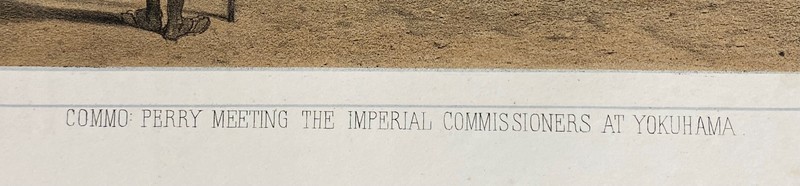


COMMO PERRY MEETING THE IMPERIAL COMMISSIONERS 1856 Lithograph Perry Expedition
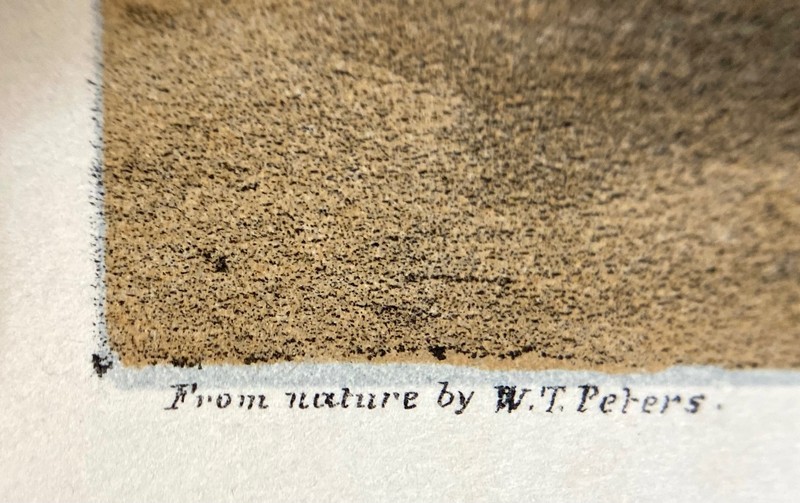
COMMO PERRY MEETING THE IMPERIAL COMMISSIONERS 1856 Lithograph Perry Expedition We are offering an original 1856 lithograph print titled "COMMO PERRY MEETING THE IMPERIAL COMMISSIONERS AT YOKUHAMA". This increasingly rare lithograph was produced through the artistic efforts of some great artists and lithographers of the time. This lithograph is from the Narrative of the Expedition of an American Squadron to the China Seas and Japan, performed in the Years 1852, 1853 and 1854 under the Command of Commodore M. C. Perry, United States Navy, dated 1856. The full page size is approximately 8 x 11 inches. The condition of this lithograph is Fine to Very Fine, clean, multi-color print. Intereestingly, this exquisite multi-colored lithograph, is credited to a New York artist, W. T. Peters. Little is known about him. His name is on the lithograph. It is known that he did not accompany the mission but he apparently worked from one of Brown's now lost daguerrotypes. This lithograph has many colors indicating that many stones or plates were used to create it. Details:Title: Commo Perry Meeting The Imperial Commissioners At Yokuhama. Artists and Lithographers: W. T. Peters, E. Brown.Date: 1856.This lithograph is over 165 years old and still looking beautifully bright and fresh!Publisher/Printer: Sarony & Co.: NY.Topic: Historical Scene.Geographic Area: Yokohama, Japan.Product Type: Lithograph. Multi tones, thusmany stone plates were used to produce this beautiful print.Condition: Very Fine, clean print with just a hint of aging at the margin edge. Approximate Size: 8 by 11 inches. Added information: For anyone not acquainted with the book which provided this print, or with the artists who actually produced it, I am providing a little information about them and the lithograph process they used.1. The book that provided this print: Narrative of The Expedition of an American Squadron to the China Seas and Japan, performed in the Years 1852, 1853, and 1854, Under The Command of Commodore M.. C. Perry, United States Navy, By Order of the Government of the United States. Compiled From the Original Notes and Journals of Commodore Perry and the Officers, at His Request, and Under His Supervision, By Francis L. Hawks, D.D. L. L. D. With Numerous Illustrations. Published By Order of the Congress of the United States. Washington: Beverley Tucker, Senate Printer. 1856. 537 pages. 2. Lithographer Peter Bernhard Wilhelm Heine, better known as Wilhelm (or William) Heine (January 30, 1827 in Dresden – October 5, 1885 in Lößnitz near Dresden) was a German-American artist, world traveler and writer as well as an officer during the American Civil War. He set up his artist studio at 515 Broadway, and soon established his reputation as an artist. After meeting the archaeologist and diplomat, Ephraim George Squier, Heine was invited to accompany him, as an artist, on his consular duties to Central America. Proceeding ahead of Squier, he collected and recorded indigenous plants and animals and compiled notes for future publications. Until Squier arrived, Heine stood in as consul, negotiating a commercial agreement between the Central American countries and the United States, which he delivered to Washington. The record of this expedition was published in 1853 as the Wanderbilder aus Zentralamerika. While in Washington, he met President Millard Fillmore and Commodore Matthew Perry, and was selected from among several scores of applicants for the post of official artist to the Perry expedition to japan. Nominally attached to Perry's expedition as an Acting Master's Mate; he served on the flagship USS Mississippi under Sydney Smith Lee. Heine visited Okinawa, the Bonin Islands, Yokohama, Shimoda and Hakodate during 1853 and 1854 (Edo, however, remained closed to the members of the American expedition, and Heine was not to visit the city until 1860, when he returned to Japan as a member of the Prussian Expedition). The sketches he produced of the places he visited and the people he encountered there, together with the daguerreotypes taken by his colleague Eliphalet Brown, Jr., formed the basis of an official iconography of the American expedition to Japan which remains an important record of the country as it was before the foreigners arrived in force. Upon his return to New York in 1855 he published several books: a collection of prints entitled Graphic Scenes of the Japan Expedition; 400 sketches which were included in Perry's official report; and his memoirs, Reiss um die Welt nach Japan (Leipzig, 1856). The memoirs were very successful, and were immediately translated into both French and Dutch.3. Lithographer Eliphalet Brown, Jr.. He was an accomplished daguerreotypist, lithographer and artist (historical, portrait and marine). In 1846 he was listed in business with James Sydney Brown, a portrait painter in New York City. The business was known as E. & J. Brown. This business terminated in 1848. In 1851 Brown worked with Charles Severyn, a lithographer, and then Currier and Ives starting in 1852. While working as a lithographer for Currier and Ives, he was chosen as the daguerreotypist to accompany Commodore Perry's expedition to Japan. It is unclear when E. Brown actually gained his skills as a daguerrotypist. He probably learned them from his brother in the period from 1848-1852. Brown was personally selected to accompany the Expedition by Commodore Perry. Apparently his knowledge and skill as an artist overcame his rather weak experience as a daguerreotypist in Perry's decision making process. This was to prove a wise choice. Brown's skills as an artist proved just as valuable to Perry as his skills as a photographer. Brown reportedly took more than 400 photographic images during the two year expedition. Nineteen lithographed plates in Volume I of the Government published Narrative of the Expedition are attributed to Brown's daguerreotypes.4. Sarony & Company: NY. Born in Quebec City, Napoleon Sarony learned lithography from his father and emigrated to New York in 1836. It was there that he worked as an apprentice for several lithographers, including Nathaniel Currier. In 1846 Sarony opened a lithographic business in partnership with Henry Major. The company went through a number of alterations in names and partnerships. Until 1853 the company was called Sarony and Major. During the 1850s and 1860's, Sarony & Company published a number of sets of important topographical views, both of foreign lands and of the recently explored American West. For some of the finest examples (such as View of Hong-Kong) Sarony created early color views by utilizing a second printing with a tint stone. Needless to say, these original ithographs are both historically and artistically valuable. Listing and template services provided by inkFrog
Specifications
| All Returns Accepted | ReturnsNotAccepted |
| Type | |
| Artist | Eliphalet Brown, Jr. |
| Theme | Americana |
| Subject | Seafaring |
| Production Technique | Lithography |
| Original/Licensed Reprint | Original |
| Style | Americana |
| Features | 1st Edition |
| Year Of Production | 1856 |
| Material | Paper |
| Size | Small |
| Time Period Produced | 1850-1899 |
| Culture | Asian |
| Region Of Origin | Japan |
| Item Height | 8 in |
| Item Width | 11 in |
| Framing | Unframed |
| Country/Region Of Manufacture | United States |
| Unit Of Sale | Single Piece |
| Image Orientation | Landscape |
| Period | Historicism (1850-1900) |
I love how this print captures the original artwork’s spirit without losing any nuance.