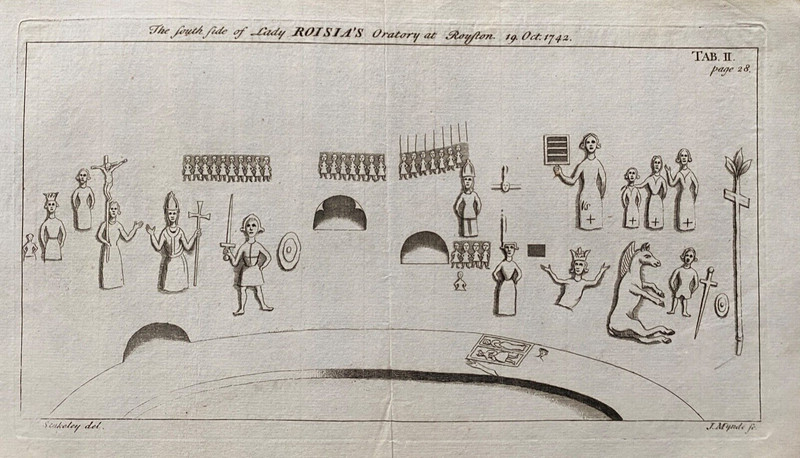


1742 Antique Print; Lady Roisia's Chapel Royston, Hertfordshire after Stukeley
On offer: an original (i.e. not a later reproduction) scarce antique print "The South Side of Lady ROISIA's Oratory at Royston. 19 Oct 1742.", Hertfordshire. DATE PRINTED: 1746 or shortly afterwards, dated 1742 on the print, the date of engraving. SIZE: The printed area including titles is approximately 31.5 x 17 cm (12.5 x 6.75 inches) plus margins with a blank back (medium) and a centre fold as issued. ARTIST/CARTOGRAPHER/ENGRAVER: Engraved by J. Mynde from a drawing by William Stukeley. William Stukeley FRS, FRCP, FSA (7 November 1687 – 3 March 1765) was an Anglican clergyman and English antiquarian who pioneered the archaeological investigation of the prehistoric monuments including Stonehenge and Avebury. He was friends with Isaac Newton and was among Newton's first biographers. PROVENANCE: This print was published by William Stukeley, in 'Palaeographia Britannica: OR, Discourses on ANTIQUITIES in BRITAIN.' 1746. TYPE: Antique copper plate engraving printed on early laid paper. VERSO: There is nothing printed on the reverse side, which is blank. CONDITION: Good; suitable for framing. Please check the scan for any blemishes prior to making your purchase. Virtually all antiquarian maps and prints are subject to some normal aging due to use and time which is not significant unless otherwise stated. I offer a no questions asked return policy. AUTHENTICITY: This is an authentic antique print, published at the date stated above. I do not offer reproductions. It is not a modern copy. The term 'original' when applied to a print means that it was printed at the first or original date of publication; it does not imply that the item is unique. RETURNS POLICY: I offer a no questions returns policy. All I ask is that you pay return shipping and mail back to me in original condition. POSTAGE / SHIPPING COSTS: I only charge postage for the first print ordered. There is no additional postage charge if you order more than one print. BACKGROUND INFORMATION: Royston was formed at the crossing of two ancient tracks; Ermine Street, a Roman road running north to south, and the older Icknield Way, running east to west. Historians have tended to attribute the name of Roisia’s Cross to a noblewoman called Lady Roisia, also translated as Rohese or Rose. William Stukeley was a famous historian who visited Royston Cave in October 1742, two months after its discovery, and concluded that it was the private chapel of Rohese de Vere, our second Lady Roisia. Please explore my ebay shop for more antique prints. Track Page Views With Auctiva's FREE Counter
Specifications
| Return Postage Will Be Paid By | Buyer |
| Returns Accepted | Returns Accepted |
| After Receiving The Item, Your Buyer Should Cancel The Purchase Within | 30 days |
| Artist | William Stukeley |
| Unit Of Sale | Single Piece |
| Size | Medium |
| Date Of Creation | Antique (Pre-1900) |
| Material | Paper |
| Original/Licensed Reprint | Original |
| Framing | Unframed |
| Subject | Landscape/ Cityscape |
| Print Surface | Paper |
| Type | |
| Listed By | Dealer or Reseller |
| Year Of Production | 1742 |
| Original/ Repro | Original |
| Theme | Topographical |
| Production Technique | Engraving |
| Country/Region Of Manufacture | United Kingdom |
| Time Period Produced | 1700-1749 |
What stands out is how the paper absorbs ink without bleeding or smudging.